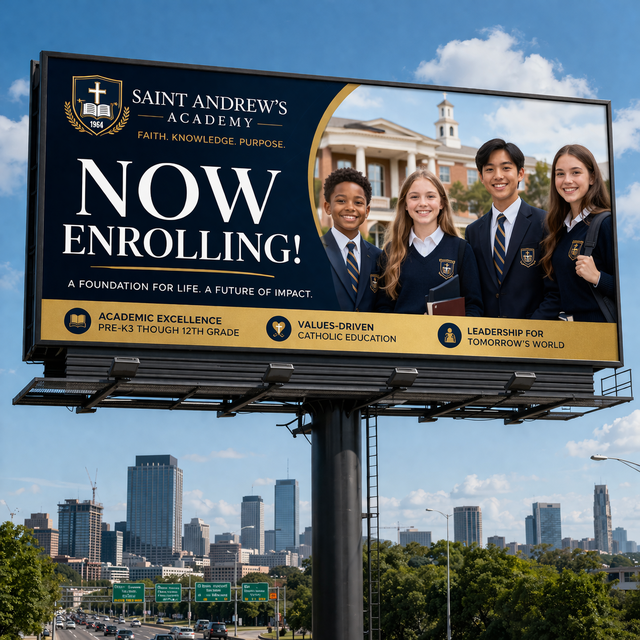
Most private and Catholic schools approach enrollment marketing the same way every year. Run an open house. Send a few mailers. Refresh the website photos. Maybe boost a Facebook post. Cross fingers.
When numbers slip, the response is usually to add more activity. More events. More ad spend. More tour invitations. Activity goes up, but enrollment doesn’t follow.
I work with private and Catholic schools across Massachusetts and nationwide on enrollment growth, and the pattern is almost always the same. The school doesn’t have an execution problem. It has a structural problem with how families experience the journey from awareness to enrollment.
Here is what actually moves enrollment in the current environment, based on the engagements I run.
Why most private school enrollment strategies stop working
Three structural patterns repeat across schools struggling with enrollment, regardless of size, region, or affiliation.
Pattern 1: The funnel is built around the open house, not the family
Most schools treat the open house as the centerpiece of the enrollment funnel. Everything points to it. Once a family attends and doesn’t apply, they fall into a generic email drip that nobody is optimizing.
But families decide on a school across many touchpoints, not one event. They visit the website at midnight after their child has a hard day at the current school. They text their spouse a link to your tuition page. They search for your school on Google and read every review. They look at social media to see whether the kids look happy.
If your funnel is built around the open house and nothing else, you are missing the actual decision moments.
Pattern 2: Messaging treats every grade level the same
Pre-K parents are choosing a school. Middle school parents are choosing a community. High school parents are choosing an outcome. These are three different decisions, and they require three different conversations.
Most schools push the same generic messaging to every prospect. Mission, values, academic excellence, beautiful campus. It sounds like every other school in your competitive set. The family hears nothing that helps them decide between you and the school down the road.
I worked with one Catholic school whose middle school enrollment was declining year over year, even while elementary stayed stable. Families were touring at the elementary level and then leaving after fifth or sixth grade. The elementary message was working. The middle school message wasn’t even being attempted as a separate message.
After we repositioned middle school as its own distinct phase, with its own funnel, its own tour experience, and its own follow-up sequence, qualified middle school inquiries went up 84 percent. Tour to application conversion went up 49 percent. Middle school enrollment grew 31 percent in one cycle.
The growth wasn’t from more activity. It was from treating middle school as a separate decision, which is what the families had already been treating it as.
Pattern 3: Nobody is asking why families don’t enroll
Most schools track inquiries and tours. Few schools track why families inquire and don’t tour. Even fewer track why families tour and don’t apply. Almost none track why families apply and don’t enroll.
Without that data, every enrollment strategy is built on guesses. You’re guessing what messaging will resonate. You’re guessing why the family across town picked the other school. You’re guessing what to fix.
A 30 minute exit interview with families who didn’t enroll, conducted respectfully and at the right moment, is one of the highest-leverage things any private school can do. The patterns surface fast. Tuition was a stretch but they would have committed if they had felt clearer about outcomes. The website didn’t make middle school feel different from elementary. The tour guide was a current parent who only talked about the lower school. These are fixable things, but only if you know they’re broken.
What actually drives enrollment growth
Three structural changes, in order of impact.
Change 1: Build a separate funnel for each major entry point
Pre-K, kindergarten, middle school, and high school are different decisions. Build a separate landing page, a separate tour experience, a separate follow-up sequence, and a separate set of testimonials for each entry grade where you have meaningful enrollment opportunity.
This sounds like more work, and it is. But the alternative is a single generic funnel that converts no one well.
Change 2: Map the actual decision journey, not the school’s preferred journey
Most school marketing maps look like this: web visit, then inquiry, then tour, then application, then enrollment. The actual family journey is messier. Web visit, then leave, then return three weeks later from a Facebook post, then ask a friend whose kid attends, then search reviews, then return to website, then call admissions, then tour, then second tour with spouse, then apply, then wait six weeks for financial aid, then decide.
Every step in the actual journey is an opportunity to either reduce friction or build confidence. Most schools optimize the steps in the preferred journey, which is not where families actually drop out.
Change 3: Treat enrollment marketing like a year-round system, not a seasonal push
The schools that grow enrollment consistently treat marketing as an always-on system. Content gets published every month. Email sequences run continuously, not just during peak enrollment season. Paid media continues at a baseline level even in summer. Tour follow-up happens within 24 hours, every time, regardless of which staff member is in the office.
AI-powered automation makes this realistic at private school staffing levels. A school marketing director with two part-time helpers can run an enterprise-grade enrollment system if the right systems are in place. Without that infrastructure, the same team will always feel underwater.
What this looks like in practice
The schools I work with on enrollment growth follow a sequence.
First, an audit. Where is the funnel actually leaking? Which grade levels have which conversion problems? Why are families saying no?
Second, repositioning by grade. Middle school becomes its own brand within the school’s brand. High school becomes its own. Each gets a dedicated landing page, dedicated content, dedicated follow-up.
Third, automation. Email sequences that run themselves. Tour confirmation and reminder workflows. Application status updates that build confidence rather than create anxiety. AI-powered content systems so the school is publishing useful information for prospective families twelve months a year, not just during peak season.
Fourth, measurement. Conversion at every step of the actual journey, not just the preferred journey. Cost per qualified inquiry by grade level. Tour-to-application conversion by tour type. Application-to-enrollment conversion by financial aid bracket.
Schools that get this right don’t always grow the fastest. But they grow consistently, year over year, even when the demographic environment is working against them.
If your enrollment is flat or declining
Adding more activity to a broken funnel just creates more activity. The fix is structural, not tactical.
If you’re a head of school, admissions director, or board member at a private or Catholic school facing flat or declining enrollment, I run 4 to 6 week enrollment audits that surface where the funnel is actually leaking and what the highest-leverage fixes are. Ranked priorities, dollar impact, and clear next steps.
I’m Lina Bifano, a marketing strategist working with private and Catholic schools across Massachusetts and nationwide on enrollment growth, fractional CMO engagements, and AI-powered marketing systems. Based in Boston. Book an exploratory call at linabifano.com.